The impact of inherently aversive contexts on visuocortical processing of generalized threat
Abstract
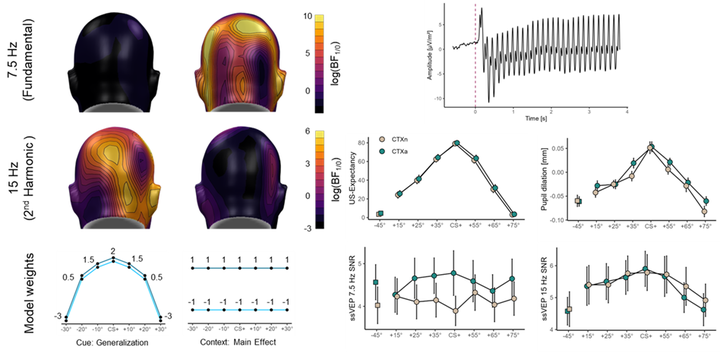
Adapting behavior to environmental demands is a fundamental aspect of survival. In the face of unfamiliar potential dangers, organisms display a wide range of defensive mechanisms, such as using contextual information to prepare for upcoming threats and extrapolating from previous experiences with similar encounters. Importantly, these different types of threat-related information place distinct demands on the attentional system, potential, context-related threat induces a state of hypervigilance, whereas imminent, acute threat requires selective attention. While these individual mechanisms are increasingly well understood, their interactions remain elusive, particularly at the neurophysiological level. Therefore, the current study aimed to orthogonally combine threat generalization with aversive contextual information and measure correlates of defensive behavior on a subjective, autonomic, and electrocortical level. Fifty-two human participants completed a threat generalization paradigm followed by a context phase in which the conditioned visual cues were presented against aversive or neutral background images, respectively. Results revealed successful threat generalization for subjective and pupillary responses with overall heightened responses for cues presented in aversive compared to neutral contexts. For visuocortical activity as measured by steady-state visually evoked potentials. this response pattern was separated into different frequencies. While the fundamental frequency showed the general main effect of aversive contexts, the second harmonic followed a generalization gradient, suggesting a segregation of competing attentional demands via neural harmonics. Together, these findings provide new insights into adaptive defensive behavior in complex situations, characterized by an additive model of different defensive processes.

Yannik Stegmann
Scientific Researcher
My research interests include fear, anxiety and anxiety disorders, as well as how aversive learning shapes perception.